

AI Learning Hub › Learn AI › Self-Paced Courses › Gemini Notebook: Working with Sources You Choose › Follow the Citation
Module 4 · Beginner to intermediate
Follow the Citation
The verification chain from a numbered citation to the passage it rests on, and the difference between a source that supports the exact wording and one that supports the underlying point.
Every grounded answer in the notebook carries small numbered chips. Clicking one is the single most useful habit this course teaches, and it takes about two seconds.
The chain, end to end
A click does two things at once. A popover opens showing the passage the number points to, with a View source link; and the left panel switches to that source, scrolled to the supporting text with the relevant lines highlighted. You can read the sentence you were given and the sentence it came from in the same glance.
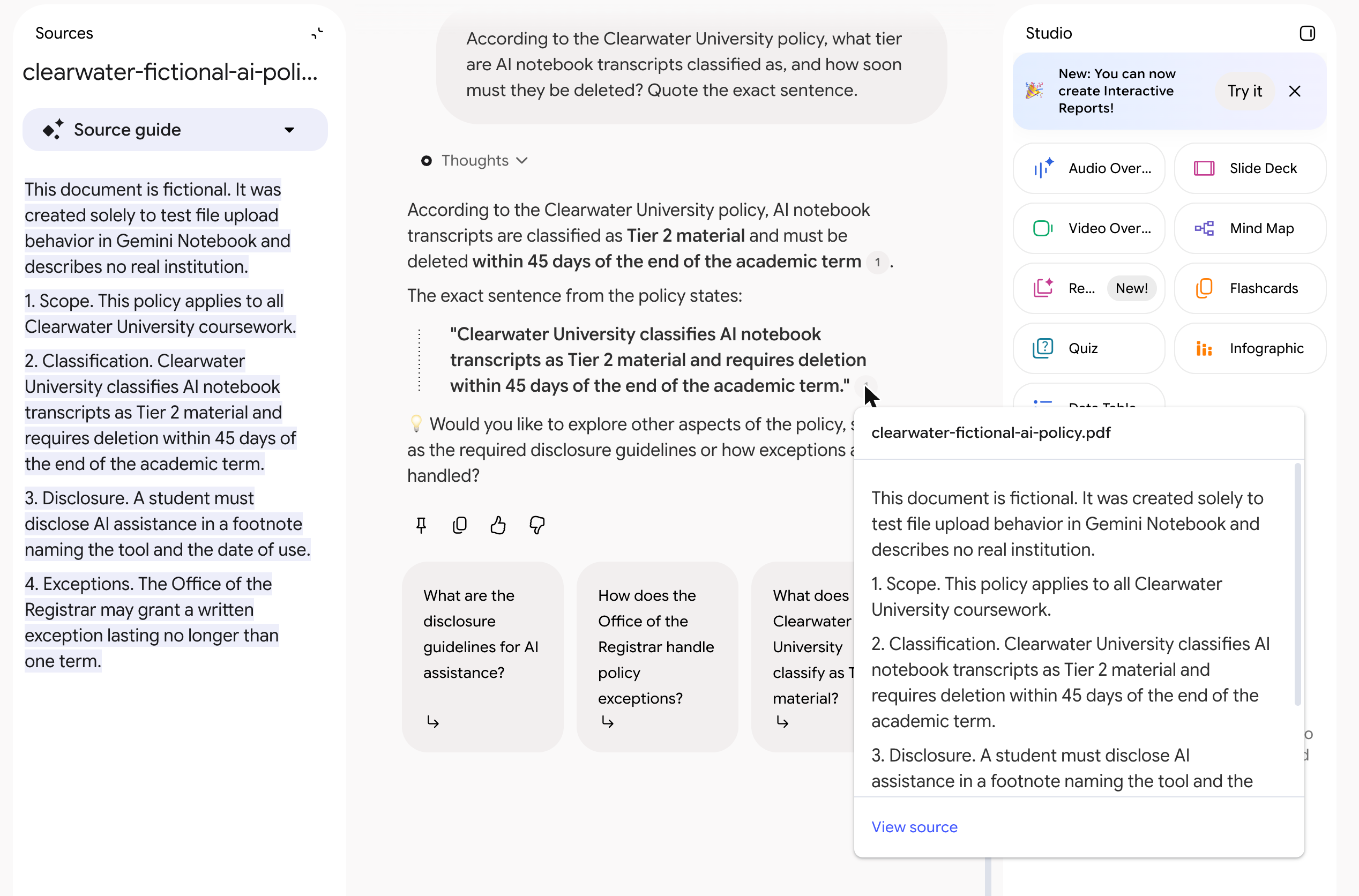
So the sequence is: read the claim, click the number, read the passage, open the source if the passage is ambiguous, and then make a judgment. The last step is the one the software cannot do.
What a citation settles, and what it leaves open
Here is a real pair from the controlled tests, and it is the most useful example in this course because nothing in it is an error.
Asked for exact wording, the notebook quoted Stanford’s service page correctly: “This service is approved for Low Risk and Moderate Data ONLY.” In a later answer, summarizing rather than quoting, it rendered the same fact as “restricted to Low Risk and Moderate Risk Data ONLY.” Both cited the same page.
The second version is a reasonable paraphrase. Stanford’s risk classifications guide does call that tier Moderate Risk, so the summary normalized the service page’s shorthand into the institution’s standard vocabulary. The underlying proposition is the same in both, and the citation supports it in both.
But a student copying the second sentence into a memo as a quotation would be attributing words to the service page that the service page does not use. The citation was never wrong; the wording simply changed in transit, and only opening the source reveals that.
A citation may support the underlying proposition while the generated wording still deserves inspection. When you intend to quote, quote from the source, not from the answer.
This is worth separating clearly from fabrication. Nothing was invented here. The failure mode is subtler and far more common: a faithful summary whose phrasing has drifted enough to matter for the use you have in mind.
Exercise: the three-way judgment
Take any answer in your own notebook that carries citations. Pick one sentence, preferably one you would want to reuse somewhere. Click its citation and read the passage. Then decide which of these is true, and write a line explaining why.
| Verdict | What it means | What you can do with the sentence |
|---|---|---|
| A. The exact wording | The source uses these words, in this order, about this subject. | Quotable, with a pinpoint citation to the source. |
| B. The underlying proposition | The source supports the point, but the phrasing is the model’s. | Usable as your own paraphrase, cited to the source. Do not present it as a quotation. |
| C. Both | The sentence is accurate and the wording matches. | Either use, though you should still cite the source rather than the notebook. |
If you decide the source supports neither
That is a real finding and worth pausing on. Check first that you are reading the right passage — the popover shows an extract, and the full source may carry qualifying language just above or below it. If the passage genuinely does not support the claim, you have found something the citation chrome did not tell you, which is exactly what the habit is for.
Run this three or four times and it stops being an exercise. The useful end state is clicking citations without deciding to, the way you would check a pin cite before relying on it.