

AI Learning Hub › Learn AI › Self-Paced Courses › Gemini Notebook: Working with Sources You Choose › Ask Against Your Sources
Module 3 · Beginner
Ask Against Your Sources
Asking questions the set can answer, asking one it cannot, and reading a refusal as information about your corpus rather than as a failure.
With a source set in place, the useful skill is reading an answer for what the sources actually establish — which is not the same as reading it for whether it sounds right. Two kinds of question make the difference visible, and it is worth running both deliberately the first time you use a notebook.
A question the sources can answer
In a notebook holding two Stanford IT pages, the question was which data classifications Gemini Notebook is approved for at Stanford, and how the risk guide defines them, asking for exact wording. The answer quoted both pages and attached a numbered citation to each claim: the approval sentence from the service page, the prohibition on High Risk Data, and the definitions of Low Risk and Moderate Risk from the classifications guide.
What makes that answer useful is not its fluency. It is that every sentence carries a number you can click, and the next module is about doing exactly that.
A question the sources cannot answer
The same notebook was then asked how long Google retains a Stanford user’s notebook content, and what Google’s published documentation says about deleting a notebook. Neither page covers either topic.
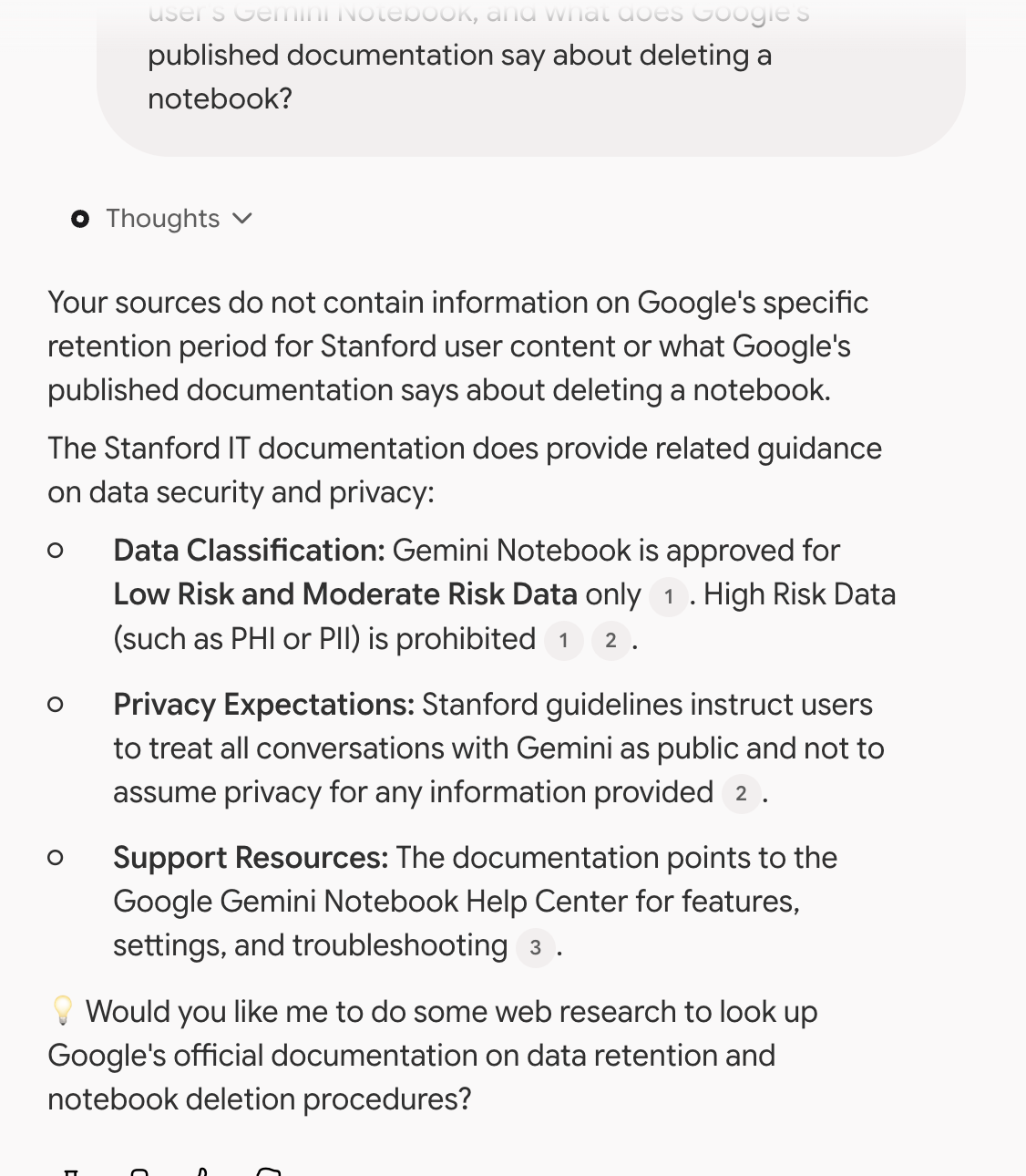
It opened with a plain statement that the sources do not contain the information, then set out the related material they do carry, with citations. That response is more valuable than it looks. It tells you something true about your corpus: you have built a set that speaks to classification and privacy expectations but says nothing about retention. If retention is what you need, the answer is to go find an authoritative source on retention, not to rephrase the question until something comes back.
A refusal is a measurement of your source set. Treat it as a result, record it, and let it drive what you add next.
One caution that belongs here rather than later: the willingness to say “not in your sources” was observed in controlled tests on particular questions. It is a designed behavior and a welcome one, and it is not a guarantee that every answer stays inside the set. That is why the verification step in the next module is a habit rather than an occasional check.
Exercise: ask both kinds
Using the notebook you built in Module 2, run two questions and record the results.
- One the set can answer. Ask something specific enough that a single source should carry it, and ask for the exact wording.
- One the set cannot. Pick something adjacent and plausible — a date, a dollar figure, an institution’s policy — that you know is not in any of your sources.
For each, write down three lines:
- What did the notebook answer?
- What did it decline to answer, or qualify?
- What does that tell you about your corpus?
If the second question produced a confident answer anyway
Then either the information was in a source you had forgotten about, or the answer drew on something outside the set. Open the citations and find out which. If there are no citations on that answer, that absence is itself the finding, and Module 5 explains the most common reason for it.