

AI Learning Hub › Learn AI › Self-Paced Courses › Lexis+ and Protégé at SLS › Draft and Refine
Module 6 · Intermediate
Draft and Refine
What a drafting request in Protégé actually knows: what happened when we relied on the conversation, what changed when we named the authority, and how a draft became a document.
By the end
- Stop assuming a drafting task inherited the research above it
- Name the authority you need in the drafting instruction
- Recognize when a draft becomes a document object
- Verify a draft’s authorities rather than its fluency
- Return to the policy question before you use it
How do you draft with Protégé without assuming it remembered the research you just did?
Drafting works through ordinary prompting — no separate mode to enter. That convenience carries an assumption worth testing, and this course tested it.
Conversation continuity does not guarantee task continuity.
What happened when we relied on the conversation
In a fresh conversation, with default settings, one research prompt asked for the four California breach-of-contract elements with Supreme Court authority. It returned a structured answer with a full source list. The very next message asked for an email using only the authorities you cited above.

Classified plainly: context not carried. The product stated that the prior authorities were not available to it. The same thing happened in an earlier controlled conversation on a different day, which is why this module exists.
Be careful how much weight this holds. Two observations are not a specification. This course does not claim that Protégé never carries context — a research follow-up in Module 4 plainly did, and produced new authorities on the strength of it. What the two tests establish is narrower and still useful: you cannot assume a drafting task received the research above it, so do not build a draft on that assumption.
What happened when we named the authority
The second test asked for the same email in a new conversation, but named the case in the instruction: Oasis West Realty, LLC v. Goldman, 51 Cal. 4th 811, 821 (2011), with an instruction to identify any additional authority separately.
The progress panel answered the question before the draft arrived.
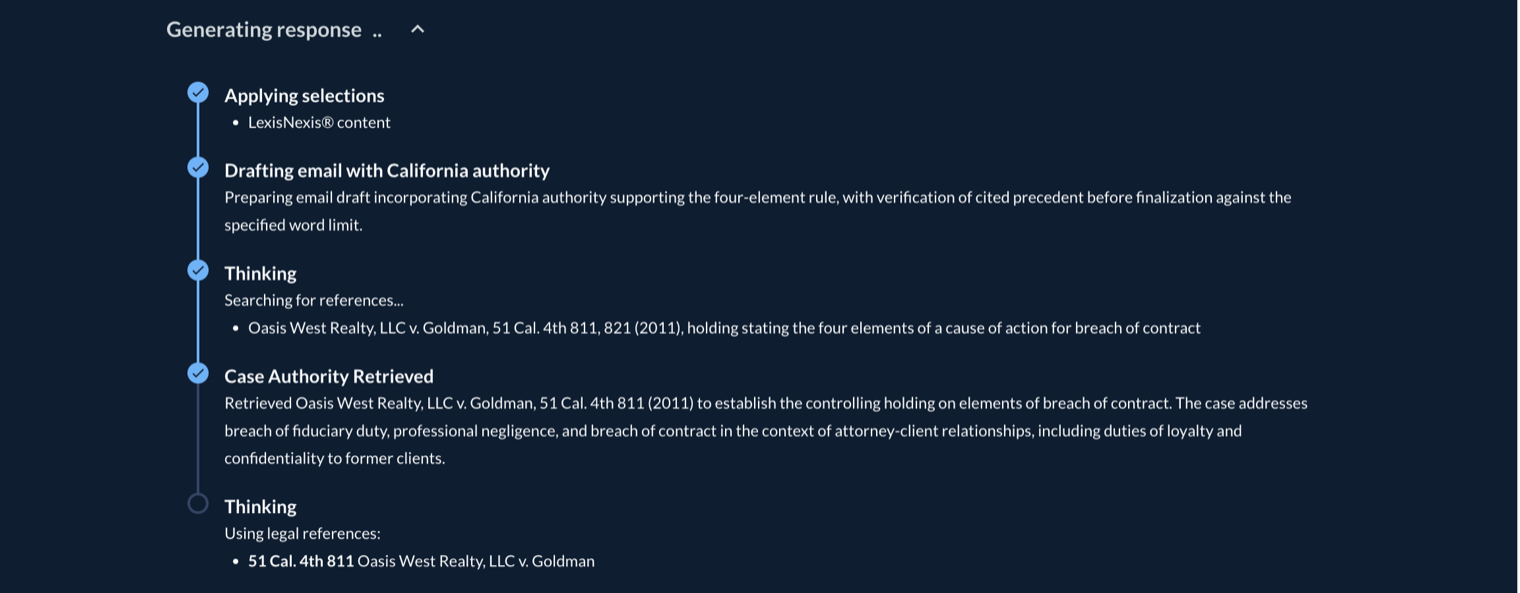
The draft that followed used that case, attributed it correctly to the California Supreme Court, cited it as a working link, and closed with a line stating that no additional authority had been relied on.
Make important context explicit when the draft depends on it.
This is a working habit, not a guarantee. Naming the authority made the constraint visible in the prompt and, in this test, visible in the retrieval steps too. It does not guarantee the product will comply, and one successful test does not establish that it will.
A draft can become a document
Something else happened in that second test, unprompted and worth knowing about.
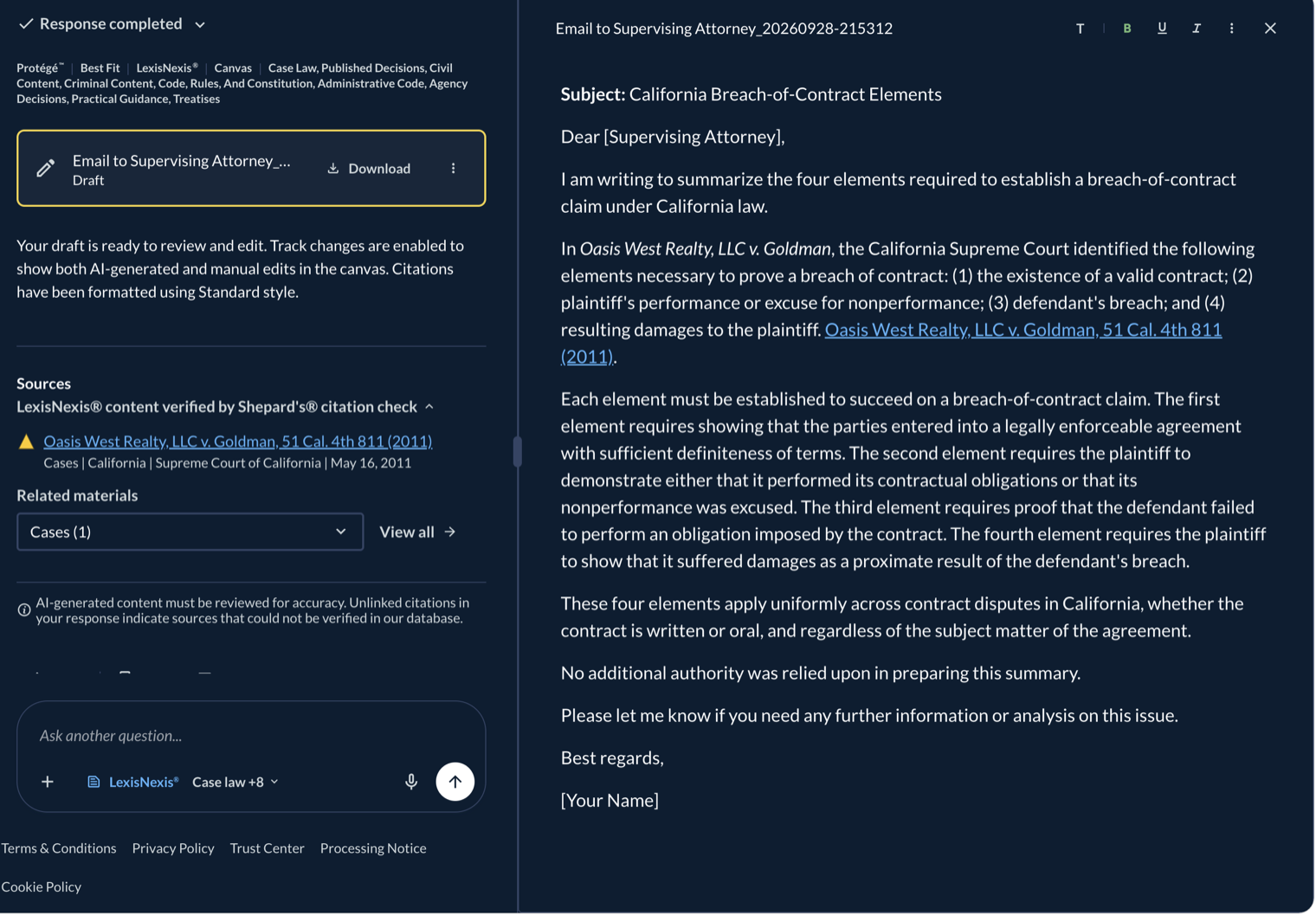
Two things changed without being asked for. Canvas appeared in the provenance line as a component of the response, and the draft became a named, timestamped document object attached to the conversation, marked Draft, with track changes enabled and a Download control.
A drafting request can create something that persists, not just a message in a conversation.
Drafting can create persistent product state
In our controlled test, a drafting request opened Canvas and created a persistent Draft document automatically. We did not explicitly select Canvas first.
Do not assume every drafting turn is only transient chat output. Notice what object the product creates and where it persists. Observed once on 28 September 2026. This course does not claim every drafting request invokes Canvas, that Canvas always creates a persistent document, or that Canvas behavior is fully documented or tested. Module 7 places this alongside the other places a document can live.
This course did not select Canvas and has not tested it. What it can report is the boundary: an ordinary drafting prompt was enough to produce a document object, so if you are being careful about what exists in your account, that is worth knowing before you ask for a draft rather than after.
One genuinely useful detail in that panel. The Sources heading read “LexisNexis® content verified by Shepard’s® citation check”, and the single authority carried its Caution signal — the same signal Module 5 inspected. A citation check is a check that the citation resolves and carries its treatment forward. It is not a check that the sentence around it is right.
Drafting is not verification
A draft with working links is the most persuasive-looking output this product makes, and it deserves the same scrutiny as an answer. Module 5 is the method; this is the checklist form of it.
- Does each cited source exist, and does the link resolve?
- Is it the right court and jurisdiction for the claim being made?
- Does the passage support the statement it is attached to?
- What does Shepard’s say, and does that treatment touch your proposition?
- Does the draft represent the source accurately, or has it drifted into a stronger claim than the case makes?
The last one is the one drafts fail most quietly. Prose smooths over qualifications that the opinion was careful about.
And then the other question
Drafting capability does not answer the authorization question.
If the draft is headed for submitted coursework, Module 2 governs: disclosure in advance of use, and explicit written authorization from the instructor before use. That the text came out of a legal database does not move it outside the rule, and neither does the fact that its citations are real.
A drafting checklist
Did I provide the necessary context explicitly? Rather than assuming the conversation carried it.
Which sources are active? The composer badges still apply to a drafting prompt.
What authorities did it actually use? Read the source list, not the prose.
Are the citations linked? And did anything arrive unlinked?
Does each authority support the statement? At the passage, not the headnote.
Did revision introduce or remove anything important? Re-read after every edit, including ones you asked to be cosmetic.
Am I authorized to use this for this task? The question the product cannot answer.
Exercise
What did the drafting task actually know?
Five situations.
A. The research above your drafting request contains several cases. The drafting response says it cannot locate them.
Show the answer for A
Do not assume the conversation interface means the drafting task received all prior context. This is the observed behavior, twice. Supply the authorities in the instruction, or ask for the draft in a way that does not depend on inherited context.
B. You need one specific Supreme Court authority to control the draft.
Show the answer for B
Name it explicitly in the drafting instruction, then verify the result. In the controlled test that produced an explicit retrieval step and a correctly attributed citation — but the verification is still yours to do, because the instruction constrains the request, not the outcome.
C. The draft contains linked citations.
Show the answer for C
Follow them. Linked does not mean the prose is accurate. Module 4’s worked example had real, linked, correctly resolving citations attached to a sentence that named the wrong court.
D. You ask only for clearer formatting — shorter paragraphs, a subject line, some bullets.
Show the answer for D
Re-check the revised legal substance and citations anyway. A regenerated draft is a new generation, not an edit applied to the old text, so nothing guarantees that only the formatting moved.
This course did not run a refinement test, so it reports no observed behavior here — the caution follows from how the drafting step works, not from something we watched go wrong.
E. The draft will be submitted for a course.
Show the answer for E
Return to Module 2 before using it. Drafting or revising any portion of submitted work sits inside the SLS rule, with both timing conditions: disclosure in advance, and written authorization before use.
The fluency of a draft is not evidence about its authorities.